Wow, what a year! I am immensely proud of the work we accomplished in 2023 at Snohomish Conservation District. We surpassed our goals and expanded our reach. It was a year of completing projects on the ground and planning new undertakings that serve marginalized communities and develop tomorrow’s habitat restoration and conservation workforce.  

In partnership with the Latino Education and Training Institute and Edmonds College, we are developing a program to provide habitat restoration training opportunities for Latino students. Students will engage with our project management team and join our field crew to learn hands-on restoration techniques. We are also partnering with the Tulalip Tribes and the Cities of Everett and Marysville to increase tree equity by planting thousands of urban street trees and creating food forests in marginalized neighborhoods. 

In addition, we are prioritizing outreach and technical assistance to new, low-income, and traditionally underserved farmers and forest landowners to improve their access to resources necessary to implement best management practices. This program will include workshops, site visits, farm and forest plans, and assistance with funding applications for projects that benefit the bottom line and protect our natural resources.

One of our most exciting projects is the creation of a Natural Resource Center at our new 12-acre scenic campus in Lake Stevens. Planning and fundraising are underway to construct indoor and outdoor environmental learning classrooms, demonstration practices, and office space for our 40+ member professional staff. 

Increasing natural resource conservation and community resiliency are collaborative processes with partners, landowners, and community members. It takes all of us working together. We are so thankful for the privilege and opportunity to partner with and serve the amazing people of Camano Island and Snohomish County. 
Keeping stormwater clean in urban spaces isn’t easy. When rain hits the ground and travels across surfaces like streets and parking lots, it picks up pollutants along the way before heading down a storm drain and into our waterways. But there are nature-based solutions, commonly referred to as Green Stormwater Infrastructure, that collect, slow, and filter stormwater. 

At Snohomish Conservation District, we utilize several green infrastructure tools to support clean water. In 2023, our Community Conservation Crew installed a 380-foot roadside bioswale in the city of Edmonds. Bioswales, which are often located alongside roads or parking lots, help manage and filter stormwater in areas where there is abundant runoff from nearby pavement. 

District staff survey the project site. CAD Technician Samantha Rudoff (right) holds a survey data receiver and rod used to collect data points and elevations to inform rain garden design. 

An excavator is used to dig a trench deep enough for the 380-foot roadside bioswale.

This bioswale (pictured unvegetated but was eventually filled with special plants) will collect and filter more water than a typical ditch or storm drain.

Bioswales are constructed by excavating a ditch, filling it with porous soils, and planting it with specially selected vegetation. The shape and soil composition of a bioswale allows it to collect more water than a ditch or storm drain and gives the collected water time to be filtered naturally as it seeps slowly into the earth below. The plants in bioswales also slow water drainage and help filter out pollutants such as 6PPD-quinone, a toxin contained in tire dust that is deadly to salmon. 

The District’s Community Conservation Crew planted the bioswale with a variety of native species, adding aesthetic value to the neighborhood. These plants also serve as habitat for pollinators and other native wildlife, and create an opportunity for residents to spot birds, bees, and butterflies. 

The 2023 bioswale project in Edmonds compliments a similar one installed by the District in 2020 just a block away, and we will be constructing another bioswale in 2024. Together, these bioswales vastly improve the neighborhood’s stormwater filtration. This is excellent news for the health of Puget Sound and the many species that live there. The District is proud to contribute to clean stormwater throughout the region.

Habitat Restoration Project Manager Thomas Bulthuis walks through the restoration project.

Highway 2 follows the braids and bends of one of Washington’s most scenic rivers, the Skykomish. This river isn’t just beautiful, the Lower Skykomish River Reach contains some of the best habitat in the Snohomish River Basin for Chinook and other salmonids. When the people living along the Skykomish River participate in efforts to revitalize the riparian zone—the area bordering the water—they can have a particularly significant impact on salmon. Establishing and maintaining a healthy buffer of native trees and shrubs in the riparian zone shades and cools the water temperature, reduces soil erosion, and supplies large and small pieces of woody debris that provide habitat for salmon, along with other fish, invertebrates, and amphibians.

Just outside of Monroe lies a property on the Skykomish River with a landowner dedicated to stewarding their riparian area. Snohomish Conservation District has been working with this landowner since 2016 and one key aspect of restoring their riparian zone has been controlling non-native, invasive species like knotweed.

Like many other rivers and streams in our region, the Skykomish River has a knotweed problem. When pieces of this non-native, invasive species break off in seasonal floods, they can easily spread downstream and grow into new plants. Once established, knotweed can exacerbate eroding banks, clog waterways, and prevent native species from establishing and growing into healthy riparian forests. All these factors disrupt the river ecosystem, in turn degrading water quality and negatively impacting the health of our salmon populations.

In order to manage the knotweed on this Skykomish property, our Washington Conservation Corps (WCC) crew applied an aquatic-approved herbicide. With careful consideration for time of year and controlled application of the herbicide, the trained and licensed crew was able to successfully manage the knotweed with less impact than if it had been removed manually, which can result in erosion and require constant maintenance. 

Once the knotweed was adequately under control, the WCC crew planted a native forest buffer along 2,900 feet of the Skykomish River to restore the riparian zone. This native vegetation would not have had the space and resources to thrive if knotweed had not been removed beforehand.

Today, eight years after the launch of this project, the knotweed remains under control and the native plants are growing and are on their way to becoming a mighty forest buffer along this critical river. 

The success of this project was the result of many key pieces coming together—a landowner committed to restoring riparian habitat on their property, a well-trained and dedicated WCC crew, ongoing funding from the Department of Ecology, and the Conservation Reserve Enhancement Program, a voluntary program that increases salmon habitat by compensating farmers for using salmon-friendly practices in riparian zones.

This project is part of a larger effort by the District, the Tulalip Tribes, Snohomish County, and many other stakeholders in the Lower Skykomish River Basin working to address knotweed in a strategic manner through the Lower Skykomish River Knotweed Management Plan

The District is dedicated to working with the many partners involved in this project, in particular the willing landowners who are so essential to the success of knotweed management and building a healthy river system.  

This project has been funded wholly or in part by the United States Environmental Protection Agency under an assistance agreement to the Washington State Department of Ecology. The contents of this document do not necessarily reflect the views and policies of the Environmental Protection Agency, nor does the mention of trade names or commercial products constitute endorsement or recommendation for use.

Established knotweed can exacerbate eroding banks, clog waterways, and prevent native species from growing into healthy riparian forests.

This sapling has protective caging to keep it safe from hungry critters.

Sarah Vecchi picks up manure in the track paddock. The composted manure will later be spread in the pasture during the growing season as a soil amendment.

Many Snohomish County and Camano Island residents have horses, but not all are aware of the effects these equine companions can have on our environment. Horses can overgraze their pastures and compact the soils, and if manure isn't managed properly it can contribute to water pollution. Luckily, Snohomish Conservation District’s Sound Horsekeeping program is available to support horse owners that seek to maximize their horses’ wellbeing while minimizing their environmental impact.

The District has served horse owners for more than 20 years. In 2023, we received over 38 assistance requests from current and prospective horse owners. These requests sought answers and advice in a number of areas related to horsekeeping, including fencing, mud management, habitat improvements, drainage, manure composting, and pasture health. Many of these horse owners were committed to safeguarding the health and well-being of their animals, land, and the surrounding area. With goals like that, we were excited to help.

Two of the many environmentally-minded horse keepers we worked with were Sarah and Jeremy Vecchi. Sarah and Jeremy own a five-acre property in Monroe where they keep and board horses. They embarked on a comprehensive journey that began with site visits and guidance from District farm planners on what best management practices would help them meet their goals while protecting the natural resources on their property. 

After weighing their options, the couple decided to pursue a track paddock and pasture rotation system. The track paddock limits horses to carefully partitioned paths—or tracks—around the edge of their pastures. It can be used year round, even during the winter when horses need to be kept off of pastures in order to prevent overgrazing and compaction. The track paddock gives horses the opportunity to move and explore their environment throughout all seasons. 

“We were surprised by just how much exercise the horses truly get with the track and how some of the inseparable best buddies end up on opposite sides of the property, doing their own thing,” reported Sarah. 

During the growing season, Sarah and Jeremy’s pasture rotation system allows them to move horses through the different pastures, giving the grass in each pasture time to regrow between grazings. Sarah and Jeremy monitor soil saturation and grass heights to help them determine when to graze a pasture and when to remove the horses. 

With the track paddock and pasture rotation system in place, Sarah and Jeremy’s pastures and horses have flourished. Together, these practices help keep horses happy while protecting soil and water quality.

Planning and implementing projects like this can happen over months or years, especially as farms evolve over time. Regardless of the scale, our farm planners are available to partner with horse owners to enhance the wellbeing of their animals, natural resources, and property.

Track paddock corridor that separates two rotational grazing pastures during the resting phase.

Horses take a break in the track paddock.

A wide track paddock corner allows for safe passage around the system when multiple horses are turned out at the same time.

Pictured: Agroforester Carrie Brausieck and intern Jared Busen at the camp.

These days, it’s becoming more common for farms to have elements we associate with restoration, such as native plant buffers and hedgerows. However, it’s less common to find the reverse—restoration areas that provide things we associate with farms. This may seem like a new concept but it’s actually modeled after indigenous cultures that lived sustainably for thousands of years. 

“Agroforestry has a pretty obvious role in farming,” said Carrie Brausieck, Snohomish Conservation District Agroforestry Program Manager. “But it has a role in restoration as well. By drawing on traditional ecological knowledge, agroforestry can go beyond regenerative farming and start to heal broken relationships between humans and the land.” 

This can be done by providing opportunities for people to be part of a sustainable, reciprocal relationship with the environment. Humans provide care through restoration work and receive food, medicine, or plant materials in return.

A view of the Skykomish River from the camp.

It’s a concept that Restoration Ecologist Paul Cereghino has thought about for a long time. Paul has supported restoration work at the National Oceanic and Atmospheric Administration (NOAA) for over 20 years, but he’s often wondered whether these efforts are enough on their own. 

“We’re doing important projects to heal large ecological wounds,” said Paul. “But it’s become obvious to me that what we may need even more is a culture that's capable of supporting and sustaining those riverscapes and forests over time.” 

This need has been recognized by a growing number of people and is referred to as Biocultural Restoration—the science and practice of restoring not only ecosystems, but also human and cultural relationships to place. (Read more about Biocultural Restoration here.)

To address this need, Paul came up with a concept loosely based on a European program. He imagined convening volunteers to camp on the land, complete restoration work, and participate in learning opportunities and recreational activities like foraging. 

Participants in the camping weekends spent the mornings installing plantings, removing invasives, or propagating native plants like red osier dogwood, cottonwood, and hazelnut to be used on restoration sites.

Paul had previously worked with the District on working buffers and realized there might be an opportunity to partner on Biocultural Restoration through our agroforestry program. He reached out to Carrie and they teamed up in search of a site where they could pilot Paul’s concept.

After meeting with several agencies, they found a match with the Tulalip Tribes who were in the process of acquiring a site on the Skykomish River.

Carrie secured funding through the Washington State Conservation Commission to start restoration work. A subaward through NOAA’s Transformational Habitat Restoration and Coastal Resilience program provided funding for broader experimentation with agroforestry to support floodplain restoration.

Jared Busen, a District intern through NOAA’s WDVA Veterans Conservation Corps Fisheries Internship Program, became a key player in 2023. He coordinated logistics, gave presentations, and collaborated with partners.

Campers weave English ivy into baskets on an afternoon.

Since fall 2022, this partnership between the District’s agroforestry program, Paul, and the Tulalip Tribes resulted in a design charrette and four field station camping weekends.   

Participants in the camping weekends spent the mornings installing plantings, removing invasives, or propagating native plants like red osier dogwood, cottonwood, and hazelnut to be used on restoration sites.

“In the afternoon, people forage or have an opportunity to learn a skill,” said Carrie. “One weekend, after pulling English ivy, a participant taught basket weaving. We all sat down together and learned how to weave the ivy into baskets.”

These activities provide community connection and recreational benefits that encourage people to volunteer long after the life of the grant-funded project and become volunteer stewards of the land, a key ingredient in a project’s success.

“Sharing meals and spending time together there builds familiarity,” said Carrie. “You get to know the trees, the river, and you see the impact of your work over time.”

This also has long-term restoration benefits. 

“Most riparian restoration grants last two to three years,” said Paul. “However, to go from a blackberry patch to a young forest typically takes seven to ten years, and these are often low in biodiversity.”

When people come back year after year, they maintain existing plantings and continue to install new species to add biodiversity. Volunteers also help manage invasive species by continually pulling up small patches before they require a large-scale solution. 

The success of the Biocultural Restoration pilot project in 2023 has resulted in its continued growth in 2024. In addition to more camping weekends and field days, Carrie and Paul plan to establish seed banks onsite. They are also contracting with a tribal ethnobotanist to cultivate culturally significant food, medicine, and materials. 

“We often frame conservation as saving nature by removing humans,” said Paul. “But I think what the land needs is for us to be present to support the regeneration of ecosystems.”

This article was prepared using Federal funds under award NA23NMF4630090 awarded to the Washington State Department of Fish and Wildlife, from the National Oceanic and Atmospheric Administration (NOAA), U.S. Department of Commerce. The statements, findings, conclusions, and recommendations are those of the author(s) and do not necessarily reflect the views of the NOAA, the U.S. Department of Commerce, or the Washington State Department of Fish and Wildlife. 

Habitat Restoration Project Coordinator Ariana Winkler stands next to a beaver dam.

Sheltered from the distant rush of passing cars and the muffled clamber of our urban world, there lies a pond. This pond is an engineering marvel made possible by a downstream dam that filters pollution, reinforces climate resilience, and provides shelter for vital species–all thanks to the hard work of a beaver.

“Beavers are smart and adaptively manage their dams,” says Ariana Winkler, Snohomish Conservation District Habitat Restoration Project Coordinator. 

Beaver dams play a pivotal role in improving salmon habitat by slowing water flow and increasing water storage. Slowing water helps settle excess sediment, which improves water quality. While dams allow some water to continue downstream, much of it seeps underground, where it recharges groundwater stores that sustain salmon and other species during the dry season. When beavers are allowed to maintain dams, they lessen downstream flooding in the winter and increase water flow in the summer, ensuring salmon have a safe place to grow all year round.

Beaver dams also create vibrant wetlands, which improve climate resilience for areas otherwise vulnerable to drought, flash flooding, or severe wildfire. In turn, these wetlands provide habitat for wildlife like herons, deer, frogs, and juvenile salmon.

While these dams positively impact the ecosystem, beavers’ industrious activity can also conflict with human use of the landscape. The District’s Living with Beavers program recognizes this tension and shares solutions that encourage harmony between beavers and humans, with the goal of allowing beavers to continue to benefit the landscape while minimizing any potential negative impacts on human activities and infrastructure. We partner with Beavers Northwest, the Tulalip Tribes, and Snohomish County to help community members coexist with local beavers. 

A beaver spots a tasty branch hanging in front of one of our project site’s wildlife cameras.

“By their very nature, it’s a ‘beaver conflict’ that we’re trying to navigate,” says Watershed Steward Alex Pittman, who works for Snohomish County Surface Water Management. “Being able to provide consistent messaging from different perspectives gives more gravitas to our advice.”

In 2023, we contributed to this messaging by providing technical assistance to 20 landowners to support their coexistence with beavers. District staff identified solutions that could be implemented on the different properties, such as installing protective caging and exclusion fencing to prevent beavers from damaging high-value trees.

However, beaver coexistence isn’t a one-step process; it’s an ongoing commitment with many factors to consider. Ken Coman, who lives with his family on a 26-acre property outside of Snohomish, knows this very well.

Ken reached out to the District three years ago to learn what he could do to care for his land. He wanted to restore salmon spawning habitat and coexist with beavers that built a dam on the property. The District worked with Ken to identify how to leverage the positive impacts of his resident beavers and invigorate his property’s riparian zone.

In an effort to support the salmon spawning potential and coexist with the beavers on Ken’s property, District crew members constructed a fence along the stream to protect riparian habitat from negative livestock impacts. The crew also treated and removed invasive blackberry, creating space for native plants. 

The beaver pond on Ken’s small farm.

In January 2023, the crew planted what will eventually become an overstory of native conifers and deciduous trees. Beavers particularly enjoy eating tender young trees, so ongoing planting will allow the beavers and riparian restoration project to coexist.

“This is a safe place for beavers,” said Ken. “We live with them.”

Partnerships with landowners such as Ken are key to the success of the District’s Living with Beavers program. 

“It’s a collaborative field,” says Beavers Northwest Executive Director Elyssa Kerr. “Beaver management is a relatively new strategy in conservation. When we work together, we’re able to share what we learn. We go to the drawing board together to change and adapt.”

We are grateful for our partnerships and collaborations with landowners and community organizations to support coexisting with beavers and restoring riparian habitat across the region. 

After all, when beavers thrive, so do we.

Funding for this program is provided in part by the Department of Ecology Streamflow Restoration grant program.

Environmental Education Program Manager Alana Springer (pictured center) with the group of students in Arlington.

“We’re going to need two volunteers for this next project. Who’s interested?”

The group of 10 high school students enrolled in the Youth Engaged in Sustainable Systems (YESS) Program eyed each other nervously. After several weeks of hands-on restoration education, these students knew they could unwittingly volunteer themselves to hold a bullfrog, chop a blackberry cane as thick as their thumb, or stomp invasive reed canary grass.

One student asked the question they were all thinking: “What are we doing?”

“Well…” Alana Springer, Snohomish Conservation District Environmental Education Program Manager, hesitated, not wanting to give away the surprise. “Let’s say what comes next will help you stay cool in this summer heat.”

Eventually two students volunteered and donned waders before joining Frida Isaken-Swensen, Washington Conservation Corps Crew Supervisor, in a hip-deep portion of Tributary 80, or Trib 80. Trib 80 is a small stream in Arlington that provides habitat to salmon and other native aquatic species. However, portions of the stream have become so narrow and fast moving that it is challenging for fish to make a home there.

To improve Trib 80’s habitat quality, Frida and the two intrepid YESS Program students worked together to build a post assisted log structure (PALS) to mimic the beneficial impact of a beaver dam. The device would encourage this section of Trib 80 to slow and widen, eventually creating pools of water perfect for spawning fish.

Before this program I had no idea what I wanted to do with my life and wasn’t planning on working in the natural resources field. Now I think I’m going to go into a field that helps the environment.
— YESS Program Student

With encouragement from other District staff and YESS Program students on the streambank, the trio of river restorationists used a post driver to secure several wooden poles in the streambed. Then they wove branch cuttings between the posts until they formed a natural barrier that slowed water flow in this portion of the stream. 

Once the final branch was woven snugly between the poles, the students were hauled back on the bank by their peers. They peeled off their waders, exhausted but grinning at the product of their labor. The exercise was a success for both the stream and the students. The PALS device would help slow the stream and the students gained firsthand restoration practice that solidified their understanding of stream dynamics, water quality, riparian habitats, and the important role beavers play in our local ecosystems.

Building the PALS was one of many hands-on experiences these students enjoyed during the five-week YESS Program held in the summer of 2023.

As a partner in the YESS Program and with support from Pacific Education Institute and Sno-Isle TECH Skills Center, District staff facilitated dozens of field and classroom lessons that introduced students to a breadth of restoration knowledge and skills.

Students left the course able to identify native and invasive species, manage invasive plants, test water quality, prepare restoration plans, and write compelling resumes and cover letters for restoration-related jobs. 

“Before this program I had no idea what I wanted to do with my life and wasn’t planning on working in the natural resources field,” said one student. “Now I think I’m going to go into a field that helps the environment.” 

District staff were honored to support these students as they learned about restoration ecology and explored conservation careers. We hope to cross paths with them in the coming years and support their continued growth in the field. 

This project has been funded wholly or in part by the United States Environmental Protection Agency under an assistance agreement to the Washington State Department of Ecology. The contents of this document do not necessarily reflect the views and policies of the Environmental Protection Agency, nor does the mention of trade names or commercial products constitute endorsement or recommendation for use.

Forester Stacey Dixon shows a diagram of the different tree species that students can find at the site.

Students wait for instruction in their waders before joining WCC Crew Supervisor Frida Isaken-Swensen in Tributary 80.

Students pose with berries they picked at the site.

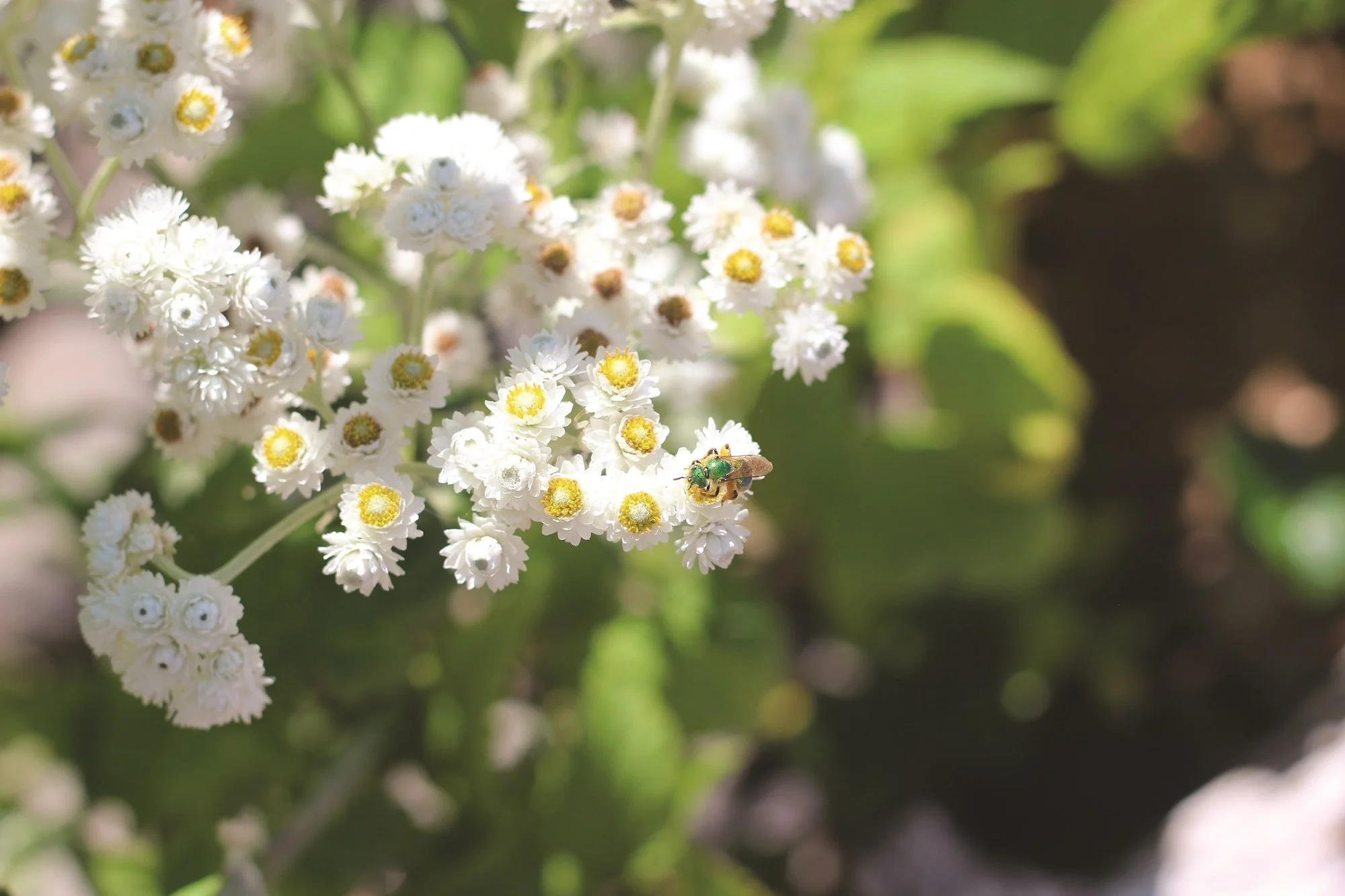
Pictured: a native bee on pearly everlasting. There are over 600 species of native bees in Washington state!

If you’re an urban resident, it might be hard to believe you can still provide important habitat for wildlife. And if you live in a rural area, the thought of adding plants when you’re surrounded by forest may feel redundant. 

This is the mindset Snohomish Conservation District is trying to change with our Homes and Habitat program. While the groundwork for this program launched in 2023, the heart behind it–inviting native plants into every space–has infused our work for decades. 

“Anywhere there are native plants, there is habitat,” said Sara Rocero, District Habitat Restoration Project Manager. “Whether it’s multiple acres or someone’s balcony, this is a program where people can find resources to support any kind of space.”

View Our Pollinator Resources

Sara is an advocate for wildlife and regularly leads nature walks and habitat workshops for the District. Last spring, she co-presented with Monica Van der Vieren of King County Wastewater Treatment for a Landscaping with Wildlife workshop. The workshop encouraged participants to consider planting habitat for native wildlife when landscaping their properties. 

Sara’s passion for backyard habitat has also inspired a guide on using multi-layered habitat–including trees, shrubs, groundcover, nurse logs, bird shelter, and other natural features–to attract wildlife.

"My hope with the Homes and Habitat program is that when you think about adding plants to a patio or yard, you consider native plants,” said Sara. “A huge bonus is that you can observe a rufous hummingbird or local butterfly that uses that plant for resources!"

One of the most exciting projects born out of the Homes and Habitat program is a partnership with local landscape architect and citizen scientist Peg Ferm. Peg has over 30 years of experience in local ecology and has observed native bees on her property for years. Washington has several hundred native bee species and they all help pollinate our farms, orchards, and native plants. 

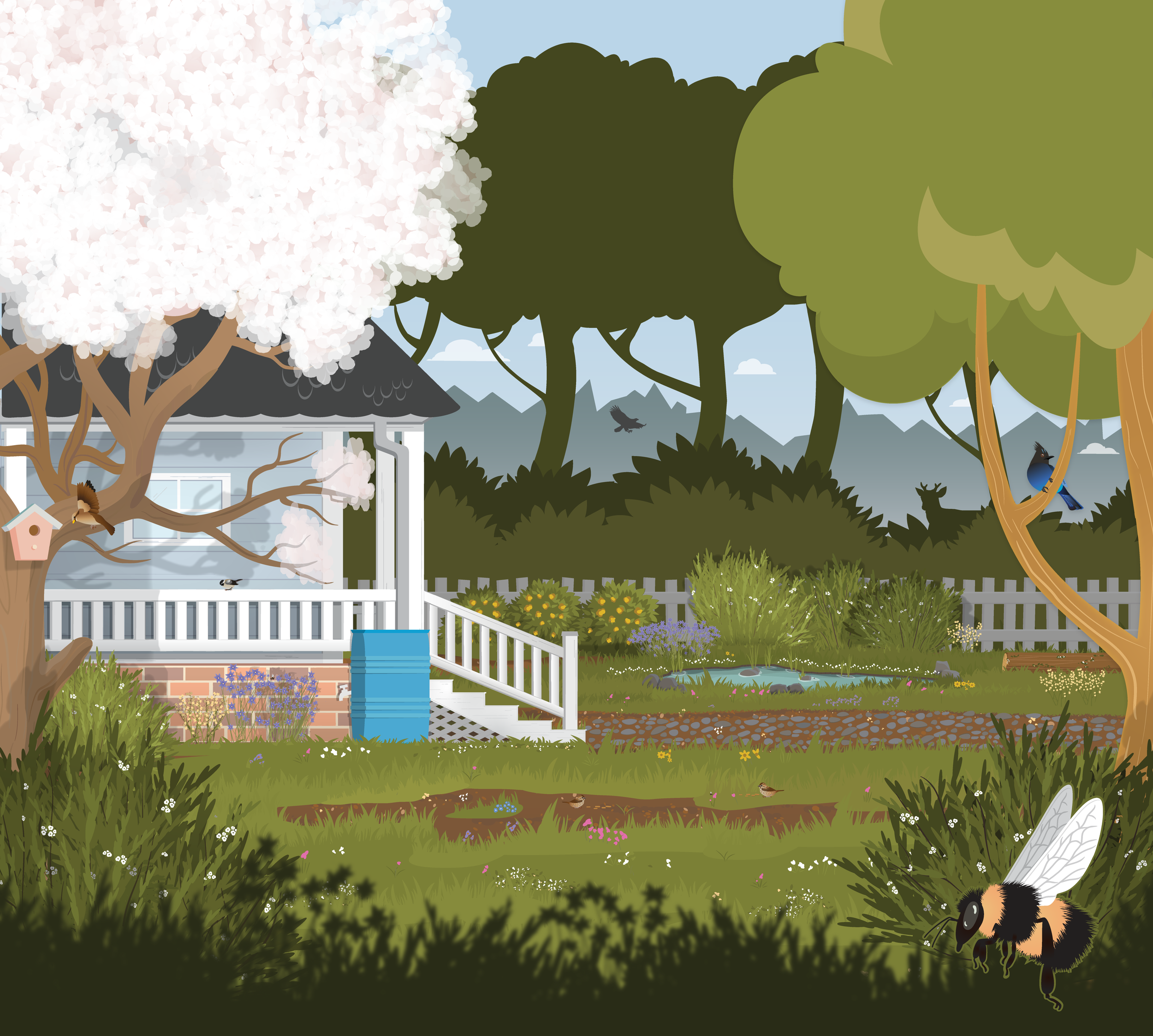
An illustration of diverse under canopy plants created as part of a guide to backyard habitat. Created by SCD Lead Designer Emma Kilgore.

“Most pollinator plant information online does not match what I see around here, so six years ago I began to keep records,” Peg said. “I’ve recorded weekly which plants are attracting bees and noted if the bees were native or non-native honeybees.”

Using data from her observations and experience as a landscape architect, Peg compiled lists of native and non-invasive plant species that support native pollinators. She also created a garden guide on how to maintain a continuous bloom of flowers that will feed bees throughout the seasons. The District is using these guides to help inform our technical assistance for community members looking to increase habitat around their home.

“Many native bees are only active for a few weeks, but bumble bees forage all season. Keep the flowers coming!” said Peg. 

The Homes and Habitat program is continuing to develop resources and classes to help residents build diverse habitats around their homes. Community members can purchase native plants at our Annual Plant Sale, and our staff are available to provide technical assistance to help Snohomish County and Camano Island meet the goals of their outdoor space.

“This program gives people agency to make an impact,” Sara says. “I hope it sparks a passion in others to see that the native plants they install provide habitat for local wildlife like birds, pollinators, and amphibians." 

With so many rivers running through Snohomish County, it is no surprise that many residents, farmers, and species–including our native salmon–face challenges from seasonal flooding. Property can be damaged, fields and livestock put at risk, and important riparian habitat can sometimes be destroyed. However, floodplains provide many social, economic, cultural, and environmental benefits.

Since 2010, when the Sustainable Lands Strategy (SLS) was first convened, Snohomish Conservation District has been part of this coalition of diverse stakeholders brought together by the shared goal of improving the coexistence of farming and fishing in Snohomish County’s floodplains.  

Collaboration is at the heart of SLS, but the pandemic prevented the face-to-face community building that is an essential element of the work. In 2023, SLS partners were finally able to gather in ways that had been inaccessible for several years.

In April, SLS collaborators attended a Farm to Table dinner at The Lodge at Sonneveldt Vineyard. They celebrated a new video about SLS efforts called “Life in the Floodplain - Skykomish, WA.”

This video features Anna and Chris Groeneveld of Groeneveld Family Farms, Morgan Ruff of Tulalip Tribes, and Andy Werkhoven of Werkhoven Dairy who also serves as an SLS Steering Committee Member. The video highlights the challenges and benefits of living in the floodplain—a place important to farmers and fish alike. 

“Flooding is a great unifier; we’re all impacted by it,” Morgan Ruff shared in the video. 

The energy in the room was warm and electric as partners connected, sharing stories and challenges about their work and experiences in the floodplain. 

It was a beautiful afternoon at the Lodge at Sonneveldt Vineyard. Quotes from “Life in the Floodplain” were displayed throughout the venue.

Agriculture Department Director Bobbi Lindemulder speaks with partners at the Farm to Table event in March 2023.

Attendees listen as interviewees from “Life in the Floodplain” share their experiences with the land and the importance of partnerships across different cultures and livelihoods.

In September, the Floodplains by Design partnership between Washington Department of Ecology, Bonneville Environmental Foundation, and America Rivers, with strong support from The Nature Conservancy (a founding organization of the Floodplains by Design partnership), hosted a Floodplains by Design Convening event.

It was the first Convening held in person after several years and was an opportunity to celebrate the people and projects that preserve farming, promote salmon habitat and livelihoods, and mitigate flooding and flood risks.

Staff from several SLS partner organizations were able to participate in the one-day event which included a field trip to visit highlighted projects at Chinook Marsh and Swans Trail Slough. 

Sustainable Lands Strategy (SLS) partners visited project sites at Chinook Marsh and Swans Trail Slough. Both projects, once completed, will help mitigate flooding and improve drainage infrastructure.

Looking ahead, the District is committed to implementing work in the floodplain, including the Swans Trail Slough multi-benefit project. Located in the Snohomish Estuary adjacent to Chinook Marsh, this project will improve drainage infrastructure and other systems in an area with recurrent flooding issues.

The completed project will improve agricultural drainage and flood protection for over 400 acres of productive farmland, enhance watershed resilience to changing river conditions, and improve up to 1.5 miles of juvenile salmonid rearing habitat in Swans Trail Slough within Drainage and Diking Improvement District 13. 

The Swans Trail Slough project presents an opportunity for regional learning about how partners can accomplish coordinated and integrated floodplain and agricultural resilience, estuary habitat restoration, viability goals, and project implementation in the Puget Sound region.

Another area of focus for the District in our work with SLS has been on reuniting partners and telling the stories about the places we hold dear. SLS and SLS partner participation in gatherings embody these values by bringing together stakeholders committed to protecting people, farms, and fish in our floodplains, and we’re excited for the work to come.

The District is grateful to support these collaborative, multi-benefit efforts that yield so many positive outcomes for such a diversity of stakeholders.

Funding to support the District’s involvement in SLS comes from a variety of sources including Floodplains by Design. Floodplains by Design is a public-private partnership working to reduce flood risk, restore habitat, and create resilient communities along Washington’s major rivers. Through this program, the Washington Department of Ecology provides grants that support locally-driven and multi-benefit floodplain projects. SLS and Floodplains by Design both rely on collaborative partnerships to seek solutions that work for all stakeholders.

Our region is facing increasingly dry and hot summers. While the warm weather is often a welcome break from the rain, it also increases wildfire risk, especially for communities in urban-wildland interface areas. Wildfires can cause significant damage to homes and properties and put human and animal lives in danger. They also cause air quality concerns as wind pushes smoke far and wide.

In an effort to reduce rural residents’ exposure to wildfire risk and poor air quality, Snohomish Conservation District partnered with Glacier Peak Institute (GPI) and the Town of Darrington to implement an Air Quality Improvement and Wildfire Risk Reduction Program in 2022 and 2023 in areas prone to higher levels of air pollution. The program consisted of community outreach, educational workshops, and a series of neighborhood wood chipper days. 

During the neighborhood chipper days, the District and GPI field crews traveled to locations around Darrington to encourage residents to create defensible space by removing wildfire-prone vegetation around their homes. They also encouraged residents to chip, rather than burn, the woody debris this produced. The crews chipped wood at a site set up at the Arlington airport and traveled to individual properties to chip wood piles too unwieldy to transport. 

“I was relieved to learn SCD had the project going as I had struck out with private chipper companies,” said one landowner. “They seemed to find the project daunting. One operator who declined the project after seeing a picture of the slash piles quipped ‘Got a match?’” 

These chipper services had the double benefit of helping residents create defensible space while preventing wood smoke from harming local air quality.

Once the woody debris was processed, landowners repurposed their new wood chips in various ways. Some retained them for landscaping or used them as ground cover to hold moisture in the soil and increase mycorrhizal communities. Others used their wood chips for cattle bedding or to mulch the forest floor. No matter the use, debris that would otherwise have been burned was instead used to support local projects.

In addition to facilitating neighborhood chipper days, the District collaborated with multiple partners to hold community workshops in Darrington and Sultan about wildfire risk, defensible space, air quality, and the need to limit outdoor burning. Partners included Puget Sound Clean Air Agency, Washington State Department of Natural Resources, Sultan Library, Sultan Fire District 5, Northwest Natural Resource Group, Town of Darrington, Glacier Peak Institute, and Snohomish County Department of Emergency Management. We are grateful for these partnerships and the residents who are taking steps to reduce wildfire risk and air pollution concerns.

The solids buildup in the manure lagoon. To create more space for liquids, the farm would have to haul the manure to other lagoons before the solids separator.

Manure is a constant presence on farms with livestock. Appropriate storage and management of manure allows it to retain the nutrients that make it such an excellent soil amendment. Proper storage also minimizes the risk that those nutrients will end up polluting our local streams, lakes, or well water. 

Peoples Creek Dairy knows all about the benefits and challenges of manure. This dairy, located south of Monroe, grows crops like grass and corn to serve as cattle feed. Once that feed leaves the cows as manure, it is stored in lagoons designed to contain liquid waste. This manure then comes full circle when it’s applied to fertilize forage crops during the growing season.

Over time, solids build up in the manure lagoons and need to be managed in order to maintain storage volume. To create more space for liquids, the farm sometimes had to haul the manure to other lagoons nearby, which is both time-consuming and expensive.

The owners determined they needed a long-term solution because they were facing the prospect of needing to apply manure during the winter, which was something they didn’t want to do. Manure application during the rainy season can cause excess nutrients to leach into ground and surface waters where they can cause water quality issues. 

Peoples Creek Dairy owner, Jon Van Nieuwenhuyzen, reached out to Snohomish Conservation District for help. He worked with Eric Schuh, the District’s Agriculture Program Manager, to identify a solution. 

“Managing manure on a farm requires a proactive approach,” said Eric. “The best alternative to reduce solids in the lagoon was to separate them from the waste stream and keep them out of the waste storage ponds in the first place.”

To facilitate this, the District took advantage of a cost share opportunity to help fund the use of a Daritech DT360 manure solids separator at Peoples Creek Dairy. The DT360 coupled with a roller press efficiently removes about 50% of solids from the waste stream and reduces them into compact dry matter. 

“The separator saves a lot of time and energy in handling nutrients when it comes time to apply it to the crops,” said Jon. “It puts the nutrients in a dry, dense form that’s easier to handle and safer to apply.”

The end result is more liquid capacity in the manure lagoons and reduced risks to water quality—a win-win for the farm and local waterways. Snohomish Conservation District is grateful for the chance to help cows and creeks through partnerships with dairy operations like Peoples Creek Dairy.

This project was funded by the Washington State Conservation Commission through their Shellfish Program.  

The Daritech DT360 manure solids separator, coupled with a roller press, efficiently removes about 50% of solids from the lagoon capacity.

Partners are an essential part of our work. Whether collaborating on a streamflow restoration project or helping us connect with families facing food insecurity, our partners share our passion and dedication to accomplishing shared goals for conservation. Stewarding the land, water, and forests today and for generations to come is possible because of the enthusiasm and dedication of our partners.

We work with farmers, landowners, and residents on a voluntary basis to provide meaningful land and resource conservation. We also engage the community in natural resource stewardship and educational opportunities. Thanks to the support and engagement of government and tribal staff as well as elected officials, non-profit organizations, schools and universities, businesses, and our citizens and land managers, we are able to have the greatest impact possible in the region. All of these stakeholders play a vital role in making conservation happen on the ground.

As non-regulatory agencies, conservation districts hold a unique role. We work hand-in-hand with federal, state, and local agencies to meet requirements and get results through voluntary action. We value broad, multi-sector partnerships and strive to bring diverse stakeholders to the table. 

If you’re interested in partnering with us in our mission-driven work or collaborating with us on a project, we’d love to hear from you. Please contact our Outreach Team at outreach@snohomishcd.org.

A special thank you to our 2023 project partners and funders…

CONSERVATION & COMMUNITY PARTNERS

A

  • Adopt-A-Stream Foundation

  • Allen Sutton, Ed.D, Washington State University  

  • American Rivers

B

  • Bastyr University

  • Bonneville Environmental Foundation

  • Burnt Ridge Orchards, Inc.

C

  • Calypso Restoration

  • Cama Beach Foundation

  • Camano Country Club HOA

  • CaravanLab

  • Carol MacIlroy Consulting 

  • Cascadia Conservation District

  • Center for Rural Livelihoods

  • City of Arlington

  • City of Bothell

  • City of Brier

  • City of Edmonds

  • City of Everett

  • City of Granite Falls

  • City of Lake Stevens

  • City of Lynnwood

  • City of Marysville

  • City of Monroe

  • City of Mountlake Terrace

  • City of Mukilteo

  • City of Snohomish

  • City of Stanwood

  • Clallam Conservation District

  • Clark’s Native Trees & Shrubs

  • Cloud Mountain Farm Center

  • Community Foundation of Snohomish County

  • Curtis Hinman and Associates

D

  • Department of Defense - US Navy

  • Drainage Improvement District 13

  • Ducks Unlimited

  • Dunbar Gardens

E

  • Eagle’s Nest

  • Eastern Klickitat Conservation District

  • Edmonds College

  • Enduris

  • Environmental Protection Agency

  • Environmental Science Associates

F

  • Farm Service Agency

  • Farmer Frog

  • Firetrail Nursery

  • Floodplains by Design

  • Food Bank Farm

  • Forterra

  • Fourth Corner Nurseries

  • Franklin Conservation District

G

  • Geo-Test Services, Inc.

  • GHD, Inc.

  • Glacier Peak Institute

H

  • H.D. Fowler Company

  • Hima Nursery

  • Hopeworks Station

  • Horizons Foundation

  • Horses for Clean Water

  • Hungry Hearts

I

  • Interfaith Family Shelter

  • Inspiration Farm

  • Island County

J

  • Jefferson County Conservation District

K

  • King Conservation District

  • King County

  • Kitsap Conservation District

  • Kittitas County Conservation District

L

  • Lake Defense Force Corporation

  • Latino Educational Training Institute

M

  • Modest Family Solutions

  • Montana State University

N

  • National Association of Conservation Districts

  • National Oceanic and Atmospheric Agency

  • Natural Resources Conservation Service

  • Natural Systems Design, Inc.

  • Northwest Meadowscapes

  • Northwest Natural Resource Group

  • Northwoods Nursery Inc.

  • Numerous Snohomish County and Camano Island farmers, residents, and community groups

O

  • O2Compost

  • One Tree Planted

  • Otak, Inc.

  • Oxbow Farm and Conservation Center

P

  • Pacific Education Institute

  • Peak Sustainability

  • Pierce Conservation District

  • Pilchuck Tree Farm

  • Puget Sound Conservation Districts

  • Puget Sound Partnership

  • Puget Sound Plants

R

  • Raedeke Associates, Inc.

  • Raising Cane Ranch

  • Rosario Archaeology LLC

S

  • Salix Solutions, LLC

  • San Juan Islands Conservation District

  • Seed2Fork

  • SHKS Architects PS Inc.

  • Silvana Community Fair

  • Skagit Conservation District

  • Skagit County Public Works

  • Snohomish County

  • Snohomish County Cattlemen

  • Snohomish County Department of Conservation and Natural Resources

  • Snohomish County Evergreen State Fairgrounds

  • Snohomish County Farm Bureau

  • Snohomish County Health Department

  • Snohomish County School Districts

  • Snohomish County Surface Water Management

  • Sno-Isle Libraries

  • Sno-Isle TECH Skills Center

  • Sno-Valley Tilth

  • Snohomish Co-Op

  • Sonneveldt Vineyard

  • Sound Native Plants, Inc.

  • Sound Salmon Solutions

  • Sound Water Stewards

  • Spark Northwest

  • Stanwood-Camano Community Fair

  • Stillaguamish Tribe 

  • Storm Lake Growers, Inc.

  • Sustainable Agriculture Research and Education

T

  • T & L Nursery, Inc.

  • Tadpole Haven Native Plants

  • Tennison Films

  • Terra Firma Consulting

  • The Nature Conservancy

  • Town of Darrington

  • Tulalip Tribes

U

  • Underwood Conservation District

  • United States Department of Agriculture

V

  • Veterans Administration

  • Volunteers of America

W

  • Washington Association of Conservation Districts

  • Washington Association of Conservation Districts Plant Material Center

  • Washington State Dairy Federation

  • Washington Association of District Employees

  • Washington Conservation Corps

  • Washington Conservation Society

  • Washington Department of Fish and Wildlife

  • Washington Farmland Trust

  • Washington Recreation & Conservation Office Salmon Recovery Funding Board and Fish Barrier Removal Board

  • Washington State Conservation Commission

  • Washington State Department of Agriculture

  • Washington State Department of Ecology

  • Washington State Department of Health

  • Washington State Department of Natural Resources

  • Washington State University Extension, Island County

  • Washington State University Extension, Snap Ed

  • Washington State University Extension, Snohomish County

  • Washington State University Livestock Advisors Program and Livestock Master Foundation

  • Washington State University Social and Economic Sciences Research Center

  • Washington Wheat Growers Association

  • Whatcom Conservation District

  • Whidbey Island Conservation District

When stormwater runs across surfaces like lawns, parking lots, and roads, it often picks up pollutants that can end up in our waterways and negatively impact salmon and other species. One way that Snohomish Conservation District helps to reduce this stormwater pollution is by partnering with community members to install rain gardens. The special soil mixtures and native plants in these gardens filter stormwater runoff and help prevent pollution from traveling downstream. Rain gardens also provide other benefits, such as attracting pollinators and providing habitat for wildlife. 

In 2023, the District’s Community Conservation Crew installed four rain gardens in the Fobes Hill neighborhood of unincorporated Snohomish County. Since Fobes Hill sits above an agricultural floodplain and the Snohomish River, stormwater runoff from the neighborhood has a direct impact on the floodplain and habitat in the watershed. These rain gardens were installed on three neighboring properties to help filter runoff that can carry pollution from cars, pet waste, yard care products, and more. 

Clusters of rain gardens like the four installed on Fobes Hill increase the cumulative environmental benefits and their visibility attracts attention, building interest among neighbors about green stormwater infrastructure and potentially inspiring them to install a rain garden on their own property. 

Staff survey the land before breaking ground. This engineer is holding a survey data receiver and rod used to collect data points and elevations to inform rain garden design. 

The ground has been prepped by replacing the grass and dirt with a special blend of high organic soil, bioretention and mulch.

The rain garden has been planted with hardy, low-maintenance native perennial plants that can withstand drought and wet root conditions.

The District held a walking tour of the Fobes Hill installations in 2023 to give neighbors and the wider community an opportunity to learn more about the benefits of rain gardens and how they work. Walking tour participants also had the chance to preview the new Rain Garden Handbook for Western Washington which our Community Conservation team helped update alongside lead author Curtis Hinman. The updated handbook is available digitally for those interested in building and maintaining their own rain garden.

Our stormwater management efforts throughout 2023 demonstrate how much we can achieve when we work with our partners and community. By installing rain gardens and educating the public about their benefits, we are able to help protect water quality and local salmon populations.

This project has been funded wholly or in part by the United States Environmental Protection Agency under an assistance agreement to the Washington State Department of Ecology. The contents of this document do not necessarily reflect the views and policies of the Environmental Protection Agency, nor does mention of trade names or commercial products constitute endorsement or recommendation for use.

SCD Environmental Educator Nathan Sharon teaches youth about the types of orcas that visit the Puget Sound

This is the trip you’ve been waiting for all year: soaking up the sun at Cama Beach on Camano Island. Harbor seals peer at you from between the waves, crabs scuttle along the rocks next to your towel, and a bald eagle soars overhead.

Next to the general store and historic gas pump, you notice children gathered around a table covered in bones and pelts. You join the fray and before you know it, you’re eye to eye with an orca skull at Snohomish Conservation District’s Conservation Station. 

The District’s Conservation Station at Cama Beach started the summer of 2021 with a handful of afternoons, grew in 2022, and fully bloomed in 2023. Our environmental educators provided visitors with hands-on activities covering a range of science topics including whales, bald eagles, pollinators, and geology. Children and adults alike stopped by to build terrariums, identify seashells, and complete plant scavenger hunts. These activities deepened visitors’ connections to the natural world and introduced them to the native plants and animals of Camano Island with the goal of inspiring environmental stewardship. 

At one science table, a young visitor had so much fun building a terrarium that he stuck around to encourage other youth to build one too. He helped our educator explain how to plant the terrarium and watched eagerly to see which native wildflower seeds other guests would choose for their planters. 

In addition to participating in these hands-on activities, visitors learned about direct conservation actions they can take, such as preventing stormwater pollution, reducing pesticide use, and creating wildlife habitat. Families leave our educational tables ready to make a positive impact in their community.

In 2023, District educators interacted with 713 people at Cama Beach State Park. However, our work on Camano Island extended well beyond our Conservation Stations. Our staff provided technical assistance and educational opportunities to Camano Island residents on topics such as living near bluffs and wetlands, choosing native plants, managing cattle pasture, and stewarding forests. 

We also engaged residents at the Stanwood-Camano Fair and partnered with Sound Water Stewards to offer watershed education at Camano Island State Park. All together, District staff interacted with over 1,000 Camano Islanders in 2023, to the benefit of the island’s people, landscapes, and species. 

Brianna Bjolstad, SCD Outreach & Communications Coordinator, smiles while holding a salmon model at Cama Beach.

Children and adults learned how to identify local salmon species.

A view of Cama beach from SCD’s booth.